
How to Use AI to Find Out If Your Therapy Practice Is Getting Found Online (And What to Do If It's Not)
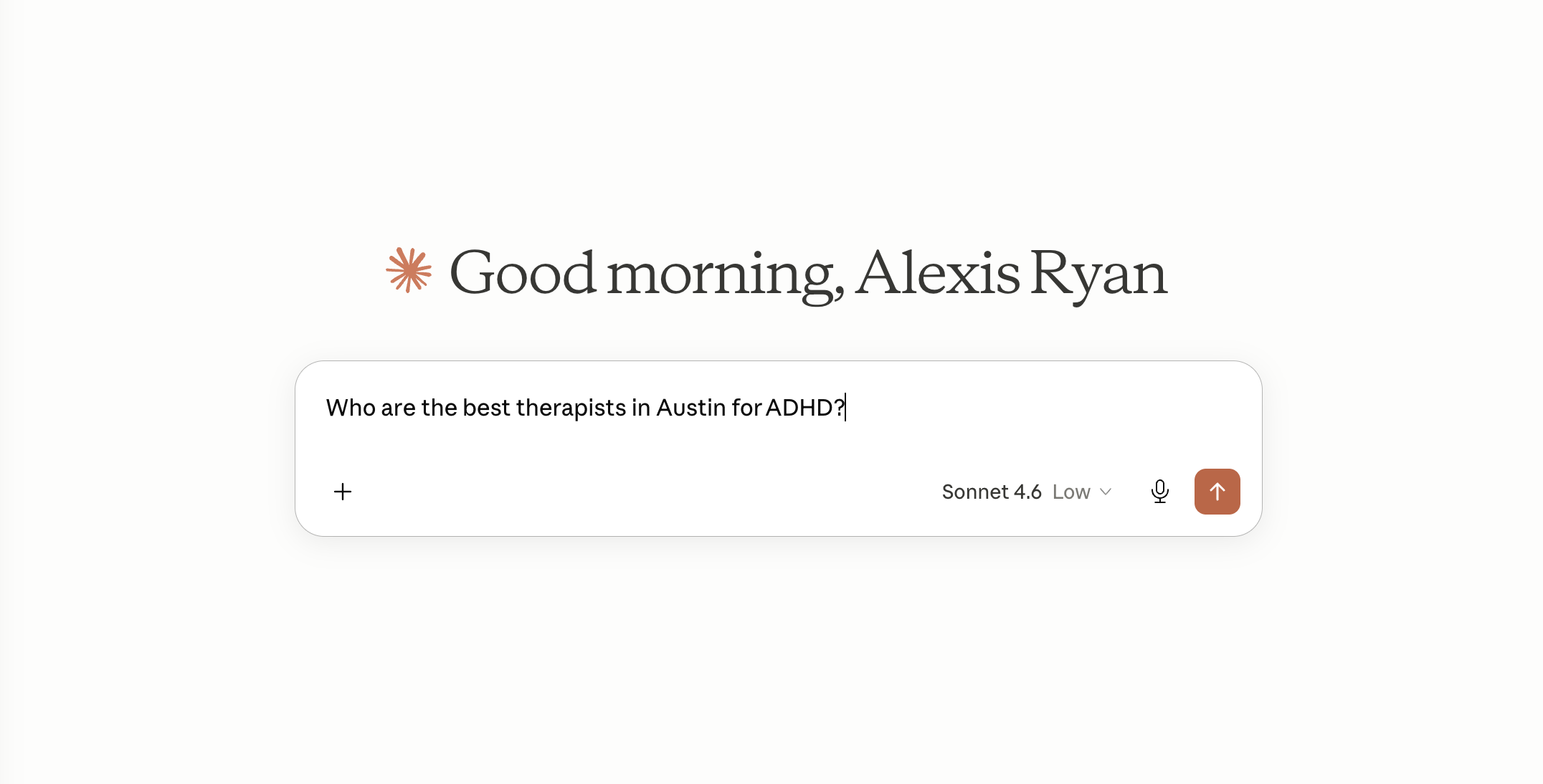
Okay, I want to try something with you. And I promise it's not as scary as it might sound.
Open a new tab, pull up ChatGPT or Google or Perplexity, and type something like this:
"Who are the best therapists in [your city] for [your specialty]?"
Go ahead. Take a second. I'll be right here.
What came up? Did your name appear? Did your practice get a mention? Was the way your work was described actually accurate — or did it sound kind of generic, like it could belong to anyone?
Or maybe, and I say this with so much gentleness, you didn't show up at all.
Whatever you found, it's okay. Truly. Most therapists who try this for the first time don't show up, and it has nothing to do with how good they are at their work or how much their clients love them. It has everything to do with how the digital world has changed, quietly, quickly, and without anyone sending us a memo.
This post is about helping you understand where you stand, what it actually means, and what small, doable steps you can take to start showing up for the people who are already out there looking for someone exactly like you.
Why This Is Worth Paying Attention To
Not too long ago, the standard advice for getting found as a therapist was pretty manageable: get on Psychology Today, fill out your Google Business Profile, maybe do a little work on your website. And honestly, that advice still holds. Those things still matter.
But the way people search for therapists has been shifting in ways that most of us haven't had time to keep up with — because we're busy, you know, actually being therapists. More and more people are skipping the directory scroll and going straight to AI tools. Not typing "therapist Denver" into Google, but asking something much more conversational: "who's a good EMDR therapist in Denver for someone dealing with childhood trauma?" or "what kind of therapist should I see for anxiety if CBT didn't really work for me?"
These tools don't spit out a list of ten links. They give a direct answer. They synthesize information from all over the web and make a recommendation — sometimes mentioning specific practices by name, sometimes describing an approach, sometimes pointing someone toward a particular kind of provider.
If your practice isn't part of that conversation, you might be missing people who would be a genuinely wonderful fit for your work. And that's worth knowing about, even if the fix takes a little time.
Step One: Run the Experiment
Pull up any AI tool — ChatGPT, Perplexity, Claude, or just Google with the AI Overview turned on. Then try a few of these prompts, filling in your own details. You don't have to do all of them — just pick the ones that feel most relevant to your practice.
Location-based:
"Who are the best therapists in [your city] for [your specialty]?"
"Can you recommend a therapist in [your city or state] who specializes in [your niche]?"
"Where can I find a good [your modality] therapist in [your area]?"
Population-specific:
"Who are good therapists for LGBTQ+ clients in [your city]?"
"Can you recommend a BIPOC therapist in [your state] who specializes in trauma?"
"What therapists in [your city] work specifically with young adults?"
Modality and approach:
"Who are the best IFS therapists in [your city]?"
"Can you find me an EMDR therapist in [your area] who works with first responders?"
"What therapists in [your city] use a somatic approach for anxiety?"
Combination searches — these are the most powerful because they're closest to how people actually search when they know what they're looking for:
"I'm looking for a queer-affirming therapist in [your city] who does EMDR for trauma — any recommendations?"
"Can you recommend a therapist in [your state] who specializes in anxiety and ADHD in adults?"
"Who are the best therapists for burnout in [your city], particularly for healthcare workers?"
Try five or six different combinations. Screenshot or copy what comes back. Then just sit with it for a minute before you react — because what you find might bring up some feelings, and that's completely normal.
Step Two: Figure Out Which Scenario You're In
Most therapists land in one of three places when they run this experiment. Here's how to gently make sense of what you found.
You show up — and it's accurate.
This is wonderful, and you should feel good about it. It means AI tools have enough clear, consistent information about your practice that they can describe you and recommend you with some confidence. Your niche is coming through. Your online presence is doing its job.
Your work now is mostly maintenance — keeping your content current, adding to it over time, and checking in occasionally to make sure the way you're being described still reflects where your practice actually is.
You show up — but something feels off.
Maybe the description is vague or outdated. Maybe it lists a specialty you've moved away from. Maybe your location is wrong, or your approach is described in a way that doesn't quite sound like you. Maybe you're mentioned but so briefly it barely registers.
This is really common, and it's usually a sign that there's some inconsistency between what different online sources say about you — your website, your directories, your Google profile are all saying slightly different things, and the AI is doing its best to piece together a coherent picture from mixed signals. Totally fixable.
You don't show up at all.
I want to be really clear about something here: this does not mean you're doing a bad job. It does not mean your practice isn't valuable or that your clients aren't out there. It almost always means one of a few things — your online presence is thin enough that AI tools don't have much to work with, your niche isn't clearly or consistently communicated anywhere, or practices with more digital content are simply showing up ahead of you.
This is the scenario with the most to address — but it's also the most common starting point, and it's genuinely workable. You just need to know where to begin.
Step Three: Ask the AI Why
Here's the part most people skip — and honestly it's where a lot of the real value lives.
Once you've done your initial searches, go back to the AI tool and start having a conversation with it. You can literally use it as a free, surprisingly thoughtful consultant to help you understand your own online presence. Some prompts to try:
To understand your visibility:
"Why might [your practice name] not come up when someone searches for therapists in [your city] for [your specialty]?"
"What would make a therapy practice more likely to show up in AI recommendations?"
"What information do you look for when recommending a therapist to someone?"
To understand your positioning:
"If someone is looking for [your specialty] in [your city], what are the most important things a therapist's website should communicate?"
"What makes one therapist's online presence stronger than another's for [your niche]?"
To get feedback on your actual content:
"I'm going to paste my therapy website's about page. Can you tell me how clearly my specialty and approach come through, and what feels missing?" [paste your text]
"Here's my homepage copy. What would make this more likely to help someone find me when they're searching for [your specialty] in [your city]?" [paste your text]
"Does this therapist bio clearly communicate who I work with and how? What would you suggest strengthening?" [paste your bio]
The answers won't be perfect — no AI tool is — but they'll give you genuinely specific, useful feedback that most of us have never had access to before. And it costs nothing but a little time.
Step Four: Understand What These Tools Are Actually Looking For
You don't need to become an SEO expert to improve your AI visibility. But it helps to have a basic sense of what these tools are pulling from and why some practices show up and others don't.
AI tools like ChatGPT and Perplexity are synthesizing information from all over the web — your website, your Psychology Today profile, your Google Business Profile, any articles or podcast appearances or blog posts connected to your name, reviews, and more. They're looking for consistency and clarity — evidence that you are who you say you are, described the same way across multiple reliable sources.
A few things that genuinely help:
A clearly defined niche, described consistently everywhere. If your website says you specialize in anxiety and trauma, your Psychology Today profile says general adults, and your Google Business Profile says nothing specific, the AI gets a blurry picture and becomes less confident recommending you for anything in particular. Getting consistent across every platform is one of the highest-leverage things you can do, and it doesn't require any technical skills.
Specific, helpful content on your website. Blog posts, FAQs, and service pages that genuinely answer the questions your ideal clients are asking give AI tools something substantive to draw from. A one-page website with minimal copy doesn't give them much to work with. The more clearly and warmly you explain your approach, your specialty, and who you help — in your own words, in your own voice — the more confidently an AI can represent you.
Your location mentioned naturally and consistently. AI tools use location signals heavily when answering city-specific searches. Your city and state should appear naturally throughout your website — not forced, just present. "I work with clients in [your city] and throughout [your region]" on your about page is infinitely more useful than having your location only in your footer or contact page.
Reviews and mentions from other sources. AI tools feel more confident recommending someone when multiple independent sources agree. Mentions in Reddit posts, comments on social media, Google reviews, directory listings, local publication mentions, podcast appearances, guest posts… all of these add up to a more robust presence that AI tools can reference with confidence.
A thoughtful FAQ section. FAQs are particularly powerful for AI visibility because they mirror the conversational question-and-answer format these tools use. A FAQ that clearly and specifically answers "Do you work with LGBTQ+ clients?" or "What does an EMDR session actually look like?" is exactly the kind of content an AI can cite when someone asks a conversational question about finding care.
Step Five: Start Small and Be Kind to Yourself About It
Here's what I really want you to hear before you close this tab.
When you run this experiment and see gaps — and most of us do — it can bring up a lot. Overwhelm. A little shame, maybe. The familiar feeling of being behind on something you didn't even know you were supposed to be doing. I know that feeling well, both from my own experience and from working with therapists who are already stretched thin just running their practices.
Please don't try to fix everything at once. That's a fast path to burning out on the whole thing and doing nothing.
Pick one thing. Just one.
If your niche isn't clearly defined anywhere online, start with your website homepage and about page. Get clear on who you help, how you help them, and where you're located. Everything else builds on that foundation.
If your information is inconsistent across platforms, spend an hour updating your Psychology Today profile and Google Business Profile so they match your website. That's it. That's the whole task.
If your content is thin, write one blog post. One real, specific, helpful post that answers a question your ideal clients are actually asking. Then write another one next month.
Small and consistent beats ambitious and abandoned every single time. I've seen it over and over again.
And if you look at all of this and think — I genuinely don't know where to start, or I know where to start but I don't have the bandwidth to get there alone — that's exactly what we're here for. You don't have to figure this out by yourself.
One More Thing Before You Go
Before you close this tab, try one more search. Go back to your AI tool and type:
"Tell me everything you know about [your practice name] in [your city]."
What comes back is essentially a snapshot of your current AI reputation — everything these tools have put together about you from across the web. It might be accurate and warm and wonderful. It might be thin. It might be a little surprising either way.
Either way, it's just information. And information — however humbling it might feel in the moment — is always, always a better place to start than not knowing.
We're Here If You Want a Second Set of Eyes
Running this experiment is the easy part. Knowing what to do with what you find — especially when your website copy and your niche messaging and your overall online presence all seem to need attention at the same time — is where having support makes a real difference.
If any of this resonated, even just a little, we'd love to hear from you. Whether you're ready to dive in or just starting to think about what a website refresh might look like, you don't need to have it all figured out before we talk. No vision board, no brand guide, no clear sense of your niche required. We'll get into the good questions, hear about your practice, and see if working together feels like the right fit.
No pressure, no pitch, no homework before you show up. Just a conversation.
